Validating Generative Software
Intelligent Agents — Module 2
A.Y. 2026/2027
Giovanni Ciatto
Compiled on: 2026-10-22 — printable version
Outline
- The general concept: why LLM-based software is hard to test, and what an evaluation is made of
- LLM-as-a-Judge, and the technological landscape of evaluation frameworks
- Examples: testing the letter-scoring system with DeepEval and MLflow
- Exercises on the running example: complete the test suite of the letter-scoring system, testing infrastructure for ID documents extraction
Recall: we assume the reader is familiar with structured outputs and with the running example, from the previous lecture
Validating generative software: the general concept
-
LLM-based software is hard to test:
- outputs are non-deterministic (same input, different outputs)
- outputs are open-ended (many correct answers, no single expected value)
- behaviour changes whenever the prompt, the model, or the provider changes, even silently
-
Hence, rather than only unit tests (pass/fail on one run), we need evaluations (a.k.a. evals): measuring how often, and how well, the system behaves as expected, on a dataset of representative inputs
- evaluations can still run on unit-test frameworks (e.g.
pytest), if assertions are on rates or thresholds, rather than on single exact outputs
- evaluations can still run on unit-test frameworks (e.g.
-
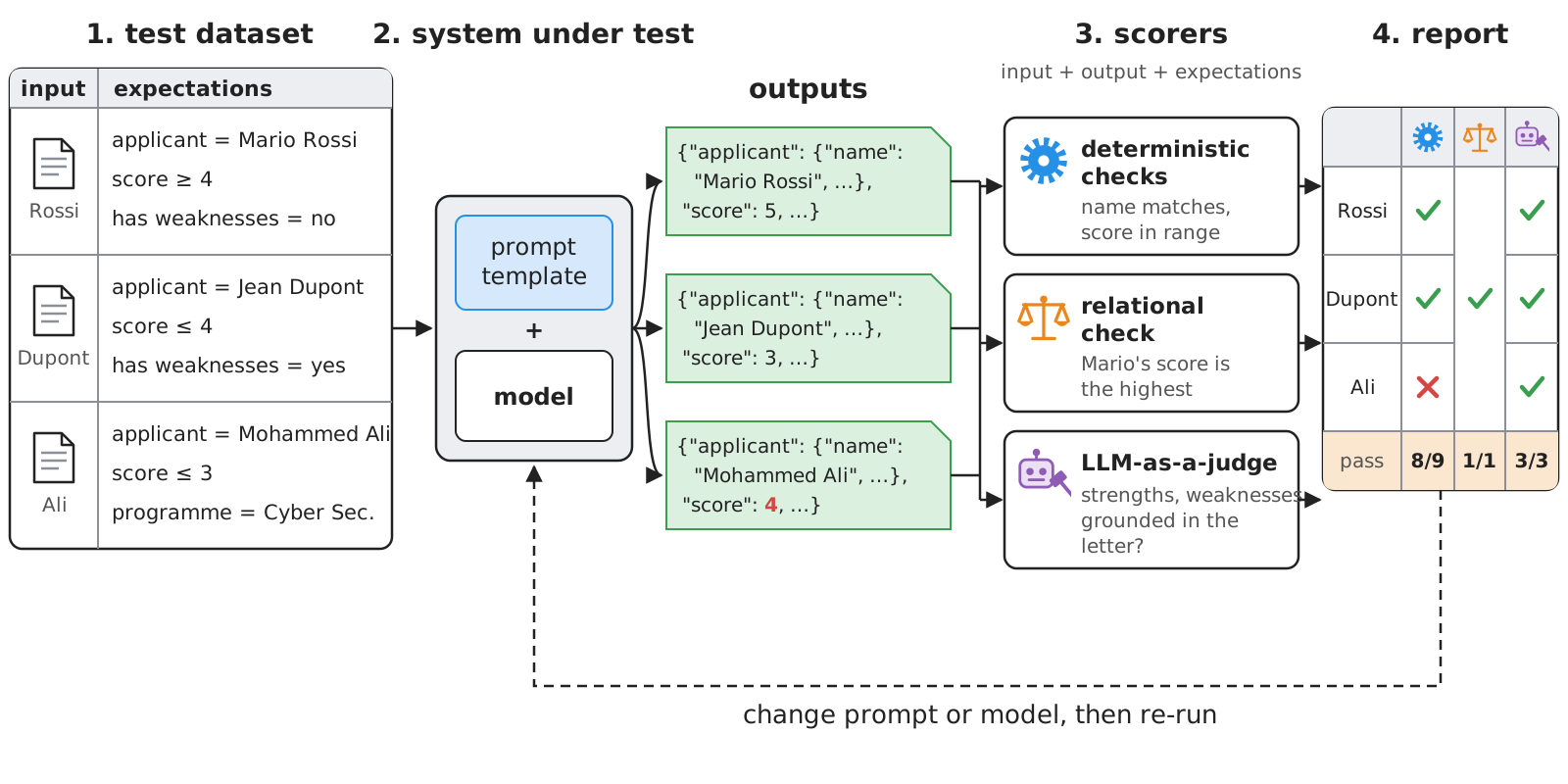
Ingredients of an evaluation:
- a test dataset: known inputs, each with the expected results (a.k.a. expectations), designed by humans before testing
- the system under test (prompt + model + code)
- scorers (a.k.a. metrics), mapping each (input, output, expectation) to a score or a pass/fail:
- deterministic scorers: schema validity, exact match, ranges, regular expressions, invariants and relations among outputs
- statistical scorers: similarity to a reference (e.g. BLEU, ROUGE, embedding similarity)
- they need a reference text, and correlate poorly with human judgement on open-ended outputs (cf. G-Eval): not used here
- LLM-as-a-Judge: another LLM grades the output, according to a natural language rubric
- humans: the most reliable, and the most expensive
- an aggregation (e.g. pass rate, mean score), to be compared across versions of the system (regression testing)
-
Structured outputs make evaluation much easier: most fields can be checked with code
Validating generative software: an intuitive example
LLM-as-a-Judge
-
Idea: use a (strong) LLM to grade outputs, according to some criteria (cf. Zheng et al. (2023), and the survey by Gu et al. (2024))
- pointwise (grade one output on a scale), or pairwise (which of two outputs is better?), with or without a reference answer
- the judge’s prompt is a rubric, and its answer is (ideally) a structured output: score + rationale
- asking for the rationale first helps (cf. chain-of-thought); G-Eval goes further, by first generating evaluation steps from the criteria
-
Known biases of judges:
- position bias (preferring the first, or the second, option in pairwise comparisons), cf. Wang et al. (2023)
- verbosity bias (preferring longer answers), and self-preference (preferring outputs of the same model family)
-
Good practices:
- use a different (and possibly stronger) model as judge, with low temperature
- prefer narrow, binary criteria (e.g. “is every strength supported by the letter?”) over vague ones (e.g. “is it good?”)
- validate the judge: compare its grades with human grades, on a small sample, before trusting it
- measure agreement: raw accuracy, plus Cohen’s κ $= (p_o - p_e)/(1 - p_e)$, which discounts chance agreement (cf. Thakur et al., 2024)
- use judges only for what cannot be checked with code
How much evidence?
- A pass rate is an estimate, and small datasets give wide uncertainty:
- e.g. 3 letters out of 3 passing $\Rightarrow$ the 95% Wilson confidence interval of the true pass rate is $[0.44, 1]$
- hence, report pass rates with confidence intervals (cf. Miller, 2024, “Adding Error Bars to Evals”)
- Outputs are non-deterministic: repeat $N$ runs per test case, and look at the distribution, not at a single run
- Comparing two versions (prompts, models) fairly:
- same test cases, same number of runs, one factor changed at a time
- compare them paired, case by case (e.g. McNemar’s test on pass/fail, or paired differences of scores), rather than comparing two averages
Evaluation frameworks: the technological landscape
| Tool | Style | Scorers / judges | Results in | Docs |
|---|---|---|---|---|
| DeepEval | unit-test like, on top of pytest |
many built-in metrics (G-Eval, hallucination, RAG, agents), custom ones | terminal; optional cloud dashboard | link |
| MLflow GenAI | experiment tracking: runs, datasets, traces | code scorers (@scorer), built-in and custom judges (make_judge) |
local (or remote) tracking server, with web UI | link |
| promptfoo | declarative (YAML), CLI, language-agnostic | assertions, model-graded rubrics, red-teaming | terminal, local web UI | link |
| OpenAI Evals | registry of evals + platform | templates, model-graded | OpenAI dashboard | link |
| Ragas | library of metrics | focused on RAG and agents | Python objects, dataframes | link |
| Inspect | framework for benchmarks and safety evals | solvers + scorers, model-graded | log viewer | link |
| LangSmith | tracing + evals, by LangChain | code and LLM evaluators | cloud dashboard | link |
- Same metamodel everywhere: dataset $\times$ system under test $\rightarrow$ outputs $\rightarrow$ scorers $\rightarrow$ report
- Differences: how datasets and scorers are declared (code vs. configuration), where results go (terminal, local UI, cloud), and batteries included (built-in metrics)
Example 1: Testing the Letter Scoring System with DeepEval (pt. 1)
Goal: set up a test suite for the LangChain letter-scoring system of Example 1 (bis) of the Prompt Engineering lecture, checking some fields of the
LetterInfoobjects it produces
- First, design the test dataset: known inputs (the letters), each with the results expected from a correct scoring
- written by humans (the committee), as a data file (
test_data.yml) shared among test suites
- written by humans (the committee), as a data file (
# Test dataset, designed by humans (the committee) BEFORE testing: known inputs (the letters), each with the results expected from a correct scoring.
# Some expectations are checked exactly (names, emails), some with tolerance (score ranges), some by an LLM-as-a-judge (descriptions).
- input: letter-mario-rossi.txt
  expectations:
    applicant_name: Mario Rossi                      # exact match
    author_name: Alessandro Bianchi                  # exact match
    author_email: alessandro.bianchi@example.edu     # exact match
    min_score: 4                                     # range
    relationship_with_applicant: >-                  # LLM-as-a-judge
      taught the applicant a Master's course (Machine Learning and Data Mining), then supervised their Master's thesis
- input: letter-jean-dupont.txt
  expectations:
    applicant_name: Jean Dupont
    author_name: Claire Moreau
    author_email: claire.moreau@example.fr
    max_score: 4
    relationship_with_applicant: >-
      taught the applicant a Master's course (Apprentissage automatique), then interacted with them in a research-oriented module
- input: letter-mohammed-ali.txt
  expectations:
    applicant_name: Mohammed Ali
    author_name: Kareem Al-Haddad
    author_email: k.alhaddad@example.edu.jo
    max_score: 3
    relationship_with_applicant: >-
      knew the applicant as one of the students of the Software Engineering programme, without supervising their final project
- adding a test case = adding an entry to the file, no code changes
- notice that each expectation is meant for a specific kind of check:
- exact match: names and emails
- tolerant match: ranges for scores
- LLM-as-a-Judge: descriptions in natural language (e.g. the author’s relationship with the applicant), as there are many correct ways to phrase them
- the file is loaded in Python as a list of
dicts- full code here:
from pathlib import Path
import yaml
import data

TEST_DATA_FILE = Path(__file__).parent / "test_data.yml"

# list of test cases, e.g. [{"input": "letter-mario-rossi.txt", "expectations": {"applicant_name": "Mario Rossi", ...}}, ...]
TEST_CASES = yaml.safe_load(TEST_DATA_FILE.read_text())
yaml.safe_load(from PyYAML) parses YAML text into Pythonlists anddictsread_letter(case), in the same file, reads the text of the case’s letter from the running example’sdata/directory
Example 1: Testing the Letter Scoring System with DeepEval (pt. 2)
-
Imports: DeepEval runs on top of
pytest, and the system under test is imported as is:import functools import os import sys import pytest from deepeval import assert_test from deepeval.metrics import GEval from deepeval.models import OpenRouterModel from deepeval.test_case import LLMTestCase, SingleTurnParams from snippets.lecture_validating.dataset import TEST_CASES, read_letter from snippets.lecture_prompting.example1bis.letter_scoring_langchain import score_letter, api_key, base_url score = functools.cache(score_letter) # this is the scoring function under test! (cached: one LLM call per letter) for_each_case = pytest.mark.parametrize("case", TEST_CASES, ids=lambda c: c["expectations"]["applicant_name"])- snippets are regular Python packages: the system under test is imported from the prompting lecture’s package, with no further configuration
functools.cacheaccepts a Python function (score_letter) and returns a cached version of it (score):- each time
score(l)is called, the cache checks if the same letterlhas already been scored - if yes, the cached output is returned; if not, the function
score_letteris called and the output is cached
- each time
- this approach allows to run multiple tests on the same letter without making multiple LLM calls
pytest.mark.parametrize("case", TEST_CASES, ids=...)is a decorator (for_each_case) making a test run once per test case, passed as thecaseargument;idsnames each run (after the applicant)api_keyandbase_urlare re-used from the system under test, so the judge talks to the same provider; DeepEval’s classes (GEval,OpenRouterModel,SingleTurnParams,LLMTestCase,assert_test) are explained in steps 5–6
Example 1: Testing the Letter Scoring System with DeepEval (pt. 3)
-
Deterministic scorers are just
pytestassertions on some fields of the structured output:# 1. deterministic scorers: plain assertions on some fields of the structured output @for_each_case def test_names_and_email(case): # exact match info, expected = score(read_letter(case)), case["expectations"] assert info.applicant.name == expected["applicant_name"] assert info.author.name == expected["author_name"] assert info.author.email == expected["author_email"] @for_each_case def test_score_in_range(case): # tolerant match info, expected = score(read_letter(case)), case["expectations"] assert expected.get("min_score", 0) <= info.score <= expected.get("max_score", 5)pytestcollects and runs everytest_*function: a failingassert(or exception) is a failing test- names and emails must match exactly; scores may vary within a range
-
Relational properties hold across inputs (a.k.a. metamorphic testing): they are robust to the variability of single scores
# 2. relational property: holds across inputs, even if single scores may vary
def test_best_letter_is_mario_rossi():
    scores = {c["expectations"]["applicant_name"]: score(read_letter(c)).score for c in TEST_CASES}
    assert scores["Mario Rossi"] == max(scores.values())
Example 1: Testing the Letter Scoring System with DeepEval (pt. 4)
-
LLM-as-a-Judge, via DeepEval’s G-Eval metric: the judge scores (in $[0, 1]$) how much the output satisfies the criteria, and the test passes if the score is above the threshold
# 3. LLM-as-a-judge: a (different) model grades what is hard to check with code judge = OpenRouterModel(model=os.environ.get("JUDGE_MODEL", "google/gemma-4-31b-it:free"), api_key=api_key, base_url=base_url) relationship = GEval( # reference-based: the judge compares the actual output with the expected one name="Relationship", criteria="The actual output describes the relationship between the author of a recommendation letter and the applicant. " "It must be consistent with the expected output: penalise contradictions, omitted key facts, and invented facts.", evaluation_params=[SingleTurnParams.ACTUAL_OUTPUT, SingleTurnParams.EXPECTED_OUTPUT], model=judge, threshold=0.7, # GEval scores are in [0, 1]: below the threshold, the test fails ) groundedness = GEval( # reference-free: the judge compares the actual output with the input letter name="Groundedness", criteria="Every skill, strength, and weakness listed in the actual output must be explicitly supported by the letter in the input. " "Penalise any invented, exaggerated, or misattributed item.", evaluation_params=[SingleTurnParams.INPUT, SingleTurnParams.ACTUAL_OUTPUT], model=judge, threshold=0.7, )- the judge is a different model than the one under test (set
JUDGE_MODELto change it), wrapped inOpenRouterModel: DeepEval’s adapter for OpenRouter (or any OpenAI-compatible API, viabase_url)- default:
google/gemma-4-31b-it:free, of a different family than the system under test (avoiding self-preference), with comparable active parameters (31B dense vs. 12B active out of 120B), free, and able to see images
- default:
evaluation_paramsselects, among the fields of a test case (SingleTurnParams.INPUT,.ACTUAL_OUTPUT,.EXPECTED_OUTPUT, …), which parts of the test case the judge can see:- reference-based judge (
relationship): compares the actual output with the expected one, written by humans - reference-free judge (
groundedness): compares the actual output with the input, no expectation needed
- reference-based judge (
- the judge is a different model than the one under test (set
Example 1: Testing the Letter Scoring System with DeepEval (pt. 5)
-
Judges are used within tests, via
assert_test, on test cases (LLMTestCase) built from some fields of the structured output:@for_each_case def test_relationship(case): letter = read_letter(case) actual, expected = score(letter).author.relationship_with_applicant, case["expectations"]["relationship_with_applicant"] assert_test(LLMTestCase(input=letter, actual_output=str(actual), expected_output=expected), [relationship]) @for_each_case def test_skills_strengths_weaknesses(case): letter = read_letter(case) actual = score(letter).applicant.model_dump_json(include={"skills", "strengths", "weaknesses"}) assert_test(LLMTestCase(input=letter, actual_output=actual), [groundedness])LLMTestCase(input=..., actual_output=..., expected_output=...): what the judge may see (strings);assert_test(case, metrics)runs each metric, and fails the test if some score is below its thresholdmodel_dump_json(include={...})serialises only the listed fields of the Pydantic objectrelationship_with_applicantis compared with the expected descriptionskills,strengths, andweaknessesare checked against the letter (are they grounded in it?)
Example 1: Testing the Letter Scoring System with DeepEval (pt. 6)
-
Files of this example, in the
lab-snippetsrepository (cf. how to set it up, and run snippets):lab-snippets/ ├── data/ │ ├── letter-jean-dupont.txt # inputs (running example) │ ├── letter-mario-rossi.txt │ ├── letter-mohammed-ali.txt │ └── __init__.py # helpers to locate data files ├── snippets/ │ ├── lecture_prompting/ │ │ └── example1bis/ │ │ └── letter_scoring_langchain.py # system under test │ └── lecture_validating/ │ ├── example1/ │ │ └── test_letter_scoring.py # the test suite │ ├── dataset.py # loads the test dataset │ └── test_data.yml # test dataset └── pyproject.toml # dependencies of all snippets- set the environment variables
OPENAI_API_KEY(and, optionally,OPENAI_BASE_URL,OPENAI_MODEL,JUDGE_MODEL), cf. Free Access to LLMs
- set the environment variables
-
Let’s run it (full code here), from the project’s root directory:
poetry run python -m snippets -l validating -e 1 -v # runs pytest on the test suite, with any option given (-v: one line per test)- would the outputs of Example 1 of the Prompt Engineering lecture pass? No: Mohammed Ali’s shallow letter got score 4, whereas the committee expects at most 3
- a test failure is information: fix the prompt (e.g. with Exercise 1 of the Prompt Engineering lecture), or the model, and re-run
- run the suite several times: which tests are flaky? Flakiness is a measure of the system’s (in)consistency
- would the outputs of Example 1 of the Prompt Engineering lecture pass? No: Mohammed Ali’s shallow letter got score 4, whereas the committee expects at most 3
Example 1 (bis): Evaluating the Letter Scoring System with MLflow (pt. 1)
-
Same test dataset, rearranged as MLflow wants it:
inputs(for the system) +expectations(for the scorers)import os import sys from datetime import datetime from typing import Literal import mlflow from mlflow.genai import scorer from mlflow.genai.judges import make_judge from snippets.lecture_validating.dataset import TEST_CASES, read_letter from snippets.lecture_prompting.example1bis.letter_scoring_langchain import score_letter, base_url, api_key # 1. the dataset: "inputs" are passed to predict_fn, "expectations" to the scorers data = [dict(inputs=dict(letter_text=read_letter(c)), expectations=c["expectations"]) for c in TEST_CASES] # 2. the system under test (outputs must be serialisable) def predict_fn(letter_text: str) -> dict: return score_letter(letter_text).model_dump()- the system under test is a function (
predict_fn), called with theinputsas keyword argumentsmodel_dump()turns theLetterInfoobject into a plaindict(outputs must be serialisable, to be logged)
- the system under test is a function (
-
Deterministic scorers are functions decorated with
@scorer, whose parameters are named after what they need (inputs,outputs,expectations,trace):# 3. deterministic scorers, on some fields of the structured output @scorer def names_and_email(outputs, expectations) -> bool: # exact match return (outputs["applicant"]["name"] == expectations["applicant_name"] and outputs["author"]["name"] == expectations["author_name"] and outputs["author"]["email"] == expectations["author_email"]) @scorer def score_in_range(outputs, expectations) -> bool: # tolerant match return expectations.get("min_score", 0) <= outputs["score"] <= expectations.get("max_score", 5)
Example 1 (bis): Evaluating the Letter Scoring System with MLflow (pt. 2)
-
Judges are created via
make_judge, with template variables in the instructions, and a structured feedback type:os.environ.setdefault("OPENAI_API_KEY", api_key) judge_options = dict(model=f"openai:/{os.environ.get('JUDGE_MODEL', 'google/gemma-4-31b-it:free')}", base_url=base_url, feedback_value_type=Literal["yes", "no"], generate_rationale_first=True) relationship = make_judge( # reference-based: the judge compares outputs with expectations name="relationship", instructions="The {{ outputs }} contain the information extracted from a recommendation letter, and the {{ expectations }} what a human expects. " "Answer 'yes' if the author's relationship_with_applicant in the outputs is consistent with the relationship_with_applicant " "in the expectations (no contradictions, no omitted key facts, no invented facts), 'no' otherwise.", **judge_options, ) groundedness = make_judge( # reference-free: the judge compares outputs with inputs name="groundedness", instructions="The {{ inputs }} contain a recommendation letter, and the {{ outputs }} the information extracted from it. " "Answer 'yes' if every skill, strength, and weakness of the applicant in the outputs is explicitly supported by the letter, 'no' otherwise.", **judge_options, ){{ expectations }}makes the judge reference-based (relationship),{{ inputs }}makes it reference-free (groundedness)generate_rationale_first=True: rationale before verdict (cf. chain-of-thought)modelis a URI (<provider>:/<model>);base_urlredirects it to any OpenAI-compatible API (the key, read fromOPENAI_API_KEY, is the same as the system under test’s)feedback_value_type: the type of the verdict, here aLiteral(cf. structured outputs) admitting only"yes"or"no"
Example 1 (bis): Evaluating the Letter Scoring System with MLflow (pt. 3)
-
Evaluation is a single call, whose results are logged as an MLflow run (named after the current date and time, in ISO format):
if __name__ == "__main__": mlflow.set_experiment("letter-scoring") # runs are grouped into experiments with mlflow.start_run(run_name=datetime.now().isoformat(timespec="seconds")): # e.g. "2026-10-01T17:36:26" results = mlflow.genai.evaluate(data=data, predict_fn=predict_fn, scorers=[names_and_email, score_in_range, relationship, groundedness]) print(results.metrics) # fraction of test cases passing each scorer, e.g. {'score_in_range/mean': 0.67, ...} failed = [name for name, value in results.metrics.items() if value != 1] # also catches NaN (scorer errors) if failed: sys.exit(f"Failed scorers: {failed}") # non-zero exit code, as a failing test suite (e.g. to make CI fail)mlflow.set_experiment(name): selects (or creates) the experiment, i.e. the group of runs to be comparedmlflow.start_run(run_name=...): a context manager opening a run, i.e. one execution whose parameters, traces, and results are loggedmlflow.genai.evaluate(...): callspredict_fnon each entry’sinputs, then applies every scorer, and logs everything in the runresults.metricsreports, for each scorer, the fraction of test cases passing it (judges’"yes"count as 1)- if some scorer does not pass on every test case, the script fails (non-zero exit code), just like a failing test suite
Example 1 (bis): Evaluating the Letter Scoring System with MLflow (pt. 4)
-
Files of this example, in the
lab-snippetsrepository (cf. how to set it up, and run snippets):lab-snippets/ ├── data/ │ ├── letter-jean-dupont.txt # inputs (running example) │ ├── letter-mario-rossi.txt │ ├── letter-mohammed-ali.txt │ └── __init__.py # helpers to locate data files ├── snippets/ │ ├── lecture_prompting/ │ │ └── example1bis/ │ │ └── letter_scoring_langchain.py # system under test │ └── lecture_validating/ │ ├── example1bis/ │ │ └── evaluate_mlflow.py # the evaluation │ ├── dataset.py # loads the test dataset │ └── test_data.yml # test dataset └── pyproject.toml # dependencies of all snippets- set the environment variables
OPENAI_API_KEY(and, optionally,OPENAI_BASE_URL,OPENAI_MODEL,JUDGE_MODEL), cf. Free Access to LLMs
- set the environment variables
-
Let’s run it (full code here), from the project’s root directory:
poetry run python -m snippets -l validating -e 1bis   # prints metrics, e.g. {'score_in_range/mean': 0.67, ...}, then: Failed scorers: [...]
poetry run mlflow ui                                  # then open http://localhost:5000, to browse runs, traces, and judges' rationales
DeepEval vs. MLflow: analogies and differences
| Aspect | DeepEval | MLflow GenAI |
|---|---|---|
| Mental model | tests: pass / fail, in CI | experiments: runs to be compared over time |
| Dataset | test cases (LLMTestCase), or pytest parameters |
list of dicts (inputs, expectations), dataframes, or managed datasets |
| System under test | called by you, inside the test | predict_fn, called by the framework (and traced) |
| Deterministic scorers | plain asserts |
@scorer functions, returning bool, numbers, or Feedback |
| LLM judges | GEval(criteria=..., threshold=...), plus many ready-made metrics |
make_judge(instructions=..., feedback_value_type=...), plus built-in judges |
| Judge model | DeepEvalBaseLLM subclasses (OpenAI, OpenRouter, Ollama, …) |
model URIs (openai:/..., anthropic:/...), plus base_url |
| Results | terminal (+ optional cloud platform) | tracking server + web UI (local, self-hosted, or managed) |
| Best for | regression tests in CI pipelines | comparing prompts / models, and monitoring in production |
- Same concepts (test dataset, deterministic scorers, judges, aggregation), different workflows: the two can coexist in a project
Exercise 1: Complete the Test Suite of the Letter Scoring System (pt. 1)
Goal: the examples above only check some fields of
LetterInfo; extend one of the two test suites (DeepEval or MLflow, your choice) so that every field is checked
Code: put your solution in
snippets/lecture_validating/exercise1/oflab-snippets, and run it viapoetry run python -m snippets -l validating -x 1
TO-DO List
- start from the project of Example 1 (or 1 bis), and list the fields which are not checked yet (cf. the
pydanticclasses inletter_scoring_langchain.py):ApplicantInfo:degree,alma_mater,attendedAuthorInfo:affiliation,position,seniority,nationalityLetterInfo:application_for
- for each field, decide how to check it, and why: exact match, tolerant match (normalisation, “contains”, ranges, set inclusion, …), or LLM-as-a-Judge (reference-based or reference-free)
- read the letters yourself, and extend
test_data.ymlwith the expectations for each field of each letter - write the corresponding scorers (tests, or
@scorerfunctions, or judges), and run the suite - for each failure, decide whether the system or the expectation is wrong, and fix the right one
Exercise 1: Complete the Test Suite of the Letter Scoring System (pt. 2)
Decision points and hints
- Optional fields (e.g.
nationality,alma_mater): what is the expected value when the letter does not mention it? How do you write it in YAML? - Normalisation: “Université de Lyon” vs. “University of Lyon”, “Associate Professor” vs. “Assoc. Prof.”: are they the same for the committee?
- Scales:
seniorityis an integer, defined by the field’s description: is the description unambiguous for every letter? - Lists (e.g.
attended): should every expected item be there? Should every extracted item be expected? Is the order relevant? - Cost: one judge per field and per letter means many requests; could a single judge check several fields at once? What would you lose?
How to test it?
- deliberately break an expectation in
test_data.yml(e.g. a wrong affiliation), and check that the suite catches it
Solution: a walkthrough follows in the next (vertical) column — try on your own first!
Exercise 1: Complete the Test Suite of the Letter Scoring System — Solution
⚠️ Spoiler alert: the walkthrough of the solution of Exercise 1 is about to start
- do not proceed until you have attempted the exercise on your own
- press → to skip the walkthrough, ↓ to see it
- the solution is on the
masterbranch oflab-snippets(whereas you cloned theexercisesbranch) - here the tests are the solution: the interesting part is the decisions behind each expectation and each check
Exercise 1 — Solution: matching conventions (steps 2–3)
# Expectations for the fields of LetterInfo NOT checked by Example 1 (whose test_data.yml covers the others), written by reading the letters.
# Conventions (decided once, for all fields, and documented here, where the committee edits them):
# - strings are matched TOLERANTLY: case-, accent-, and punctuation-insensitive, the expected text must be CONTAINED in the actual one
# - a list of strings means: any of them is fine (e.g. a title, in the original language or translated)
# - `null` means: the letter does not say it, so the field must be empty (YAML's null = Python's None)
# - `attended` lists courses which must ALL be among the extracted ones (others may be there too, in any order)
- input: letter-mario-rossi.txt
  expectations:
    degree: master
    alma_mater: null                     # the letter never says where Mario studied (Bologna is the author's affiliation!)
    attended: [machine learning and data mining]
    affiliation: university of bologna
    position: associate professor
    seniority: [3]                       # admissible values (a list, in case of ambiguity)
    nationality: null                    # never stated
    application_for: data science
- conventions decided once, for all fields, and written in the dataset, where the committee edits it
- a list means “any of these is fine”: translations, synonyms, or several admissible values of an ambiguous scale
nullmeans “not stated in the letter”: the model must not guess- e.g. Mario’s
alma_mater: Bologna is the author’s affiliation, not the applicant’s university
- e.g. Mario’s
Exercise 1 — Solution: the ambiguous cases
- input: letter-jean-dupont.txt
  expectations:
    degree: [master, informatique]
    alma_mater: [universite de lyon, university of lyon]
    attended: [apprentissage automatique, vision par ordinateur]
    affiliation: [universite de lyon, university of lyon]
    position: [maitresse de conferences, associate professor, lecturer]  # a French title, maybe translated
    seniority: [1, 2, 3]                 # ambiguous: "maîtresse de conférences" is a tenured lecturer, i.e. 1, 2, or 3 depending on the mapping
    nationality: null
    application_for: artificial intelligence
- input: letter-mohammed-ali.txt
  expectations:
    degree: software engineering
    alma_mater: [university of amman, null]   # implied ("our academic programme", the author works there), not stated: both are fine
    attended: [databases, computer networks]
    affiliation: university of amman
    position: associate professor
    seniority: [3]
    nationality: [null, jordan]          # "Amman, Jordan" is the author's address, not their nationality: a model may conflate them
    application_for: cyber security
- reading the letters yourself reveals ambiguity the prompt never resolved:
- “maîtresse de conférences” →
seniority1, 2, or 3? - Mohammed’s
alma_materis implied, not stated: bothnulland Amman are fine - “Amman, Jordan” is the author’s address, not their nationality
- “maîtresse de conférences” →
- each ambiguity is either accepted in the expectations (lists) or fixed in the field description of the prompt
Exercise 1 — Solution: re-use and tolerant matching (steps 2–3)
from snippets.lecture_validating.dataset import read_letter
# the tests of Example 1 (names, email, score, relationship, skills/strengths/weaknesses): imported, hence collected and run here too.
# `score` is the same cached scoring function, so each letter is still scored only ONCE, across old and new tests
from snippets.lecture_validating.example1.test_letter_scoring import (
    score, test_names_and_email, test_score_in_range, test_best_letter_is_mario_rossi, test_relationship, test_skills_strengths_weaknesses,
)

# step 3: the new expectations (same inputs as Example 1's test data)
TEST_CASES = yaml.safe_load((Path(__file__).parent / "test_data.yml").read_text())
for_each_case = pytest.mark.parametrize("case", TEST_CASES, ids=lambda c: c["input"])


# step 2: tolerant matching, i.e. normalisation + containment (cf. the conventions in test_data.yml)
def normalise(text: str | None) -> str:
    """e.g. 'Maîtresse de Conférences.' -> 'maitresse de conferences'"""
    text = unicodedata.normalize("NFKD", text or "").encode("ascii", "ignore").decode()  # strips accents
    return " ".join(text.lower().translate(str.maketrans(string.punctuation, " " * len(string.punctuation))).split())

def matches(actual: str | None, expected: str | list | None) -> bool:
    """Whether the actual value matches the expected one (or any of them, if a list), as per the conventions in test_data.yml."""
    if isinstance(expected, list):
        return any(matches(actual, e) for e in expected)
    if expected is None:  # the letter does not say it: nothing (or an explicit "unknown", which some models write) is expected
        return not actual or normalise(actual) in {"none", "null", "unknown", "not specified", "not mentioned", "n a"}
    return actual is not None and normalise(expected) in normalise(actual)
- Example 1’s tests are imported, hence collected and run here too, and share the same cached
score: one LLM call per letter, for all tests normalisehandles case, accents, punctuation:unicodedata.normalize("NFKD", ...)splits “é” into “e” + accent, then.encode("ascii", "ignore")drops the accentstr.maketrans+translateturn everystring.punctuationchar into a blank
matchesadds containment (“University of Bologna” ⊇ “bologna”) and the list /nullconventions- some models write
"unknown"instead ofNone: accepted as empty (a choice: you may want to forbid it)
Exercise 1 — Solution: one test per group of fields (step 4)
# step 4: one test per group of fields, with the most appropriate kind of check
@for_each_case
@pytest.mark.parametrize("field", ["degree", "alma_mater"])
def test_applicant_studies(case, field):  # tolerant match
    actual = getattr(score(read_letter(case)).applicant, field)
    assert matches(actual, case["expectations"][field]), f"{field}: {actual!r}"

@for_each_case
def test_attended_courses(case):  # set inclusion: every expected course is among the extracted ones (order, and extra ones, do not matter)
    actual = score(read_letter(case)).applicant.attended
    missing = [course for course in case["expectations"]["attended"] if not any(matches(a, course) for a in actual)]
    assert not missing, f"missing courses: {missing}, extracted: {actual}"

@for_each_case
@pytest.mark.parametrize("field", ["affiliation", "position", "nationality"])
def test_author_info(case, field):  # tolerant match
    actual = getattr(score(read_letter(case)).author, field)
    assert matches(actual, case["expectations"][field]), f"{field}: {actual!r}"

@for_each_case
def test_author_seniority(case):  # exact match, among admissible values (as the scale is ambiguous for some positions)
    actual = score(read_letter(case)).author.seniority
    assert actual in case["expectations"]["seniority"]

@for_each_case
def test_application_for(case):  # tolerant match
    actual = score(read_letter(case)).application_for
    assert matches(actual, case["expectations"]["application_for"]), f"application_for: {actual!r}"
- tolerant match for free-text fields; set inclusion for
attended(order and extra courses don’t matter); exact match among admissible values forseniority - parametrised over fields too (stacked
parametrizedecorators = every letter $\times$ every field): a failure names the letter and the field - no LLM-as-a-Judge needed: all these fields are short facts, which code checks cheaply and deterministically
- judges stay where they were (relationship, groundedness), cf. the cost hint
Exercise 1 — Solution: Project Structure
Files of this solution, in the lab-snippets repository (branch master):
lab-snippets/
├── data/
│   ├── letter-jean-dupont.txt               # inputs (running example)
│   ├── letter-mario-rossi.txt
│   └── letter-mohammed-ali.txt
└── snippets/
    ├── lecture_prompting/
    │   └── example1bis/
    │       └── letter_scoring_langchain.py  # system under test
    └── lecture_validating/
        ├── example1/
        │   └── test_letter_scoring.py       # Example 1's tests (re-used)
        ├── exercise1/
        │   ├── test_all_fields.py           # the complete test suite
        │   └── test_data.yml                # expectations for the other fields
        ├── dataset.py                       # loads Example 1's test dataset
        └── test_data.yml                    # Example 1's test dataset
poetry run python -m snippets -l validating -x 1 -v # runs pytest on the complete suite, with any option given
- then break an expectation (e.g. a wrong
affiliation) and check that the suite catches it
Exercise 2: Testing Infrastructure for ID Document Extraction (pt. 1)
Goal: the committee wants evidence that the extractor of Exercise 2 of the Prompt Engineering lecture is reliable, and wants to be warned whenever a change in prompt or model makes it worse
Code: put your solution in
snippets/lecture_validating/exercise2/oflab-snippets, and run it viapoetry run python -m snippets -l validating -x 2
TO-DO List
- first, design a test dataset from the 3 passports of the running example: for each picture, write down the expected values of all fields (name, nationality, date of birth, ID number, expiration date)
- pick a framework (DeepEval or MLflow), and write deterministic scorers:
- exact match for ID numbers and dates, normalised match for names and nationality (case, accents, order of words)
- invariants: date of birth < expiration date, candidate is of age, etc.
- measure consistency: run the extractor $N$ times per picture, and report the agreement rate per field
- compare single queries vs. majority voting (as in Exercise 2 of the Prompt Engineering lecture): does voting improve accuracy?
- add an LLM-as-a-Judge only where code can’t help (e.g. “is the document legible enough to trust the extraction?”), and validate it against your own judgement
- run the suite with at least two models, and write down which one you’d pick, and why (cf. the Governance lecture)
Exercise 2: Testing Infrastructure for ID Document Extraction (pt. 2)
Decision points and hints
- Where should the test dataset live? (code, YAML/JSON file, a managed dataset?) Who is allowed to change it?
- Tolerance: which fields must be exactly right, and which ones may be flagged for human review instead?
- Cost: $N$ samples $\times$ 3 pictures $\times$ $M$ models $\times$ (1 + judge) requests: keep $N$ small while developing, and use
:freemodels (cf. Free Access to LLMs) - Flakiness: a test that fails 1 time out of 10 is telling you something; consider asserting on rates (e.g. “at least 4 out of 5 runs are correct”) rather than on single runs
- Do not cache LLM responses while measuring consistency (cf. Exercise 1 of the LLM-as-a-Service lecture)
How to test it?
- deliberately break the system (e.g. remove the field descriptions from the Pydantic class, or use a tiny model) and check that the suite catches it
- run it in CI (e.g. GitHub Actions), with the API key stored as a secret
Solution: a walkthrough follows in the next (vertical) column — try on your own first!
Exercise 2: Testing Infrastructure for ID Document Extraction — Solution
⚠️ Spoiler alert: the walkthrough of the solution of Exercise 2 is about to start
- do not proceed until you have attempted the exercise on your own
- press → to skip the walkthrough, ↓ to see it
- the solution is on the
masterbranch oflab-snippets(whereas you cloned theexercisesbranch) - here the tests are the solution: the extractor under test is the one of Exercise 2 of the Prompt Engineering lecture, unchanged
Exercise 2 — Solution: the test dataset (step 1)
# Test dataset of the ID-document extractor, designed by humans (the committee) by LOOKING at the pictures, BEFORE testing.
# It is a file (not code), so that the committee can review and extend it without touching the tests.
# Values are as written in the VISUAL zone of each passport (beware: the machine-readable zone may disagree, e.g. Mario Rossi's expiry date).
- input: passport-mario-rossi.png
  expected:
    name: Mario Rossi
    nationality: Bananense
    date_of_birth: 1985-03-15            # YAML parses ISO dates as dates
    id_number: BN1234567
    expiration_date: 2034-05-20
    legible: true                        # my own judgement, to validate the LLM-as-a-judge against
# step 1: the test dataset (a file, not code: cf. passports.yml)
TEST_CASES = yaml.safe_load((Path(__file__).parent / "passports.yml").read_text())
for_each_case = pytest.mark.parametrize("case", TEST_CASES, ids=lambda c: c["input"])
SAMPLES = int(os.environ.get("SAMPLES", 3))  # cost: SAMPLES x 3 pictures requests (+ 3 for the judge): keep it small while developing
FIELDS = list(IDDocumentInfo.model_fields)


@functools.cache  # NOT a cache of LLM responses across runs (that would hide variance), just one batch of samples per picture per run
def samples_of(picture: str) -> list[IDDocumentInfo]:
    return sample(data.DIR / picture, SAMPLES)
- a YAML file, written by looking at the pictures, before testing: the committee reviews it without touching code
- which zone is the truth? The visual one: the machine-readable zone of Mario’s passport disagrees on the expiry date
legible: human judgement, used later to validate the judgeSAMPLES(env var, default 3) is $N$;IDDocumentInfo.model_fieldslists the names of the fields of the Pydantic classsample(from Exercise 2 of the Prompt Engineering lecture) queries the model $N$ times on the picture indata.DIR(the running example’sdata/directory)samples_ofcaches samples within a run only: caching across runs would hide the variance we want to measure
Exercise 2 — Solution: deterministic scorers (step 2)
# step 2: deterministic scorers, i.e. exact match for IDs and dates, normalised match for names and nationality (case, accents, order of words)
def normalise_words(name: str) -> set[str]:
    """e.g. 'DUPONT Jean' -> {'jean', 'dupont'}"""
    return set(unicodedata.normalize("NFKD", name).encode("ascii", "ignore").decode().lower().replace(",", " ").split())

def correct(info: IDDocumentInfo, expected: dict, field: str) -> bool:
    actual = getattr(info, field)
    if field in {"name", "nationality"}:
        return normalise_words(actual) == normalise_words(expected[field])
    if field == "id_number":
        return actual.strip().upper() == expected[field]
    return actual == expected[field]  # dates: `date` objects on both sides, so the format does not matter

def accuracy(results: list[IDDocumentInfo], expected: dict) -> float:
    """Fraction of correct fields, over all fields of all results."""
    return sum(correct(r, expected, f) for r in results for f in FIELDS) / (len(results) * len(FIELDS))


@for_each_case
@pytest.mark.parametrize("field", FIELDS)
def test_voted_field_is_correct(case, field):  # the system, as the committee would use it, i.e. with voting
    voted, agreement = vote(samples_of(case["input"]))
    assert correct(voted, case["expected"], field), f"{field}: {getattr(voted, field)!r} (agreement: {agreement[field]:.0%})"
- exact match for ID numbers (up to blanks and case) and dates (
dateobjects on both sides: the format is irrelevant) - normalised match for names (and nationality): a set of words, so “DUPONT Jean” = “Jean Dupont”
vote(samples)returns the voted object, and the agreement rate of each field (cf. Prompt Engineering’s Exercise 2)- the test checks the voted result, i.e. the system as the committee uses it;
agreementin the message tells how sure it was
Exercise 2 — Solution: invariants, consistency, voting (steps 2–3)
# invariants: checked on EVERY sample, as they must hold whatever the expected values are
@for_each_case
def test_invariants(case):
    for info in samples_of(case["input"]):
        assert info.date_of_birth < info.expiration_date
        assert (date.today() - info.date_of_birth).days >= 18 * 365.25, "candidates must be of age"
        assert info.id_number.strip(), "ID number must not be empty"


# step 3: consistency, i.e. agreement rate per field, asserted on RATES (not on single runs), to avoid flaky tests
@for_each_case
def test_consistency(case):
    _, agreement = vote(samples_of(case["input"]))
    print(f"\n{case['input']} agreement: {agreement}")  # visible with -s
    inconsistent = {field: rate for field, rate in agreement.items() if rate < 2 / 3}
    assert not inconsistent, f"fields with less than 2/3 agreement: {inconsistent}"


# ... and does voting improve accuracy w.r.t. single queries? (a measure, rather than a requirement: it fails only if voting makes things WORSE)
def test_voting_vs_single_queries():
    single = sum(accuracy(samples_of(c["input"]), c["expected"]) for c in TEST_CASES) / len(TEST_CASES)
    voted = sum(accuracy([vote(samples_of(c["input"]))[0]], c["expected"]) for c in TEST_CASES) / len(TEST_CASES)
    print(f"\n[{vision_model}] accuracy of single queries: {single:.0%}, of voted ones: {voted:.0%}")
    assert voted >= single
- invariants hold whatever the expected values: checked on every sample
- consistency is asserted on rates (≥ 2/3 agreement), not on single runs: fewer flaky failures
- voting vs. single queries is a measure more than a requirement: it fails only if voting makes things worse
- read the printed accuracies with
-s(pytestoption: do not captureprintoutputs)
- read the printed accuracies with
Exercise 2 — Solution: a validated LLM-as-a-Judge (step 4)
# step 4: LLM-as-a-judge, only for what code cannot check (legibility), with a (different) multimodal model
class Legibility(BaseModel):
    reasoning: str = Field(description="Which parts of the document are hard to read, if any, and why (e.g. stamps, glare, blur).")
    legible: bool = Field(description="Whether name, date of birth, document number, and expiry date are legible enough to trust an automatic extraction.")

# (better a DIFFERENT model than the system under test, set via JUDGE_MODEL: by default, the same is used, as few free models support images)
judge = ChatOpenAI(base_url=base_url, api_key=api_key, model=os.environ.get("JUDGE_MODEL", vision_model), temperature=0)
legibility_judge = judge.with_structured_output(Legibility)

@for_each_case
def test_legibility_judge_agrees_with_humans(case):  # validates the judge against my own judgement (in passports.yml)
    verdict = legibility_judge.invoke([
        SystemMessage("You assess the quality of pictures of ID documents, before any information is extracted from them."),
        message_with_image("Is this document legible enough?", data.DIR / case["input"]),
    ])
    assert verdict.legible == case["expected"]["legible"], verdict.reasoning
- legibility is the only property code can’t check: hence the only judge
reasoningcomes beforelegible: the judge explains, then decides (and the explanation is the failure message)- the test does not trust the judge: it checks the judge agrees with human judgement (
legiblein the dataset) - ideally a different model than the system under test, but few free models accept images
Exercise 2 — Solution: Project Structure
Files of this solution, in the lab-snippets repository (branch master):
lab-snippets/
├── data/
│   ├── passport-jean-dupont.png             # inputs (running example)
│   ├── passport-mario-rossi.png
│   └── passport-mohammed-ali.png
└── snippets/
    ├── lecture_prompting/
    │   └── exercise2/
    │       └── id_extraction.py             # system under test (sample, vote)
    └── lecture_validating/
        └── exercise2/
            ├── passports.yml                # test dataset
            └── test_id_extraction.py        # the test suite


VISION_MODEL=<model 1> poetry run python -m snippets -l validating -x 2 -v -s   # -s shows agreement rates and accuracies
VISION_MODEL=<model 2> poetry run python -m snippets -l validating -x 2 -v -s   # step 5: run once per model, compare the reports
SAMPLES(default 3) sets $N$;JUDGE_MODELthe judge (must accept images)
What’s next?
- So far, the LLM only reads and writes text (or JSON), and we know how to measure how well it does so
- Next, we’ll let it act: calling tools (functions) to get data or change the world, i.e. building agents
- structured output is the enabling technology: a tool call is nothing but a structured output, matching the tool’s signature
Check your understanding
-
Answer in your own words, motivating your conclusions and using examples where useful.
-
Questions asking whether something is possible or desirable require more than a yes/no answer.
-
Implementation questions can be answered with an explanation or pseudocode unless executable code is explicitly requested.
-
Labels identify the primary learning target:
- notions (knowledge), reasoning (drawing conclusions), or know-how (applying knowledge).
- theoretical questions are independent of particular technologies; practical questions concern their use.
-
Practical answers should identify the technology used, without requiring memorisation of product-specific details (model names, prices, API signatures, versions, limits).
Check your understanding (1/4)
Designing evaluations
-
[notions, theoretical] What makes generative software difficult to test? Describe the ingredients of an evaluation and explain how evaluations relate to ordinary unit tests.
-
[know-how, theoretical] How would you construct a representative test dataset for a document-processing application? Discuss how to establish expectations when the source is ambiguous, incomplete, or internally contradictory.
-
[reasoning, theoretical] How would you choose between deterministic checks, similarity metrics, an LLM judge, and human assessment? Give examples where a convenient metric would measure the wrong thing.
-
[know-how, theoretical] How would you check extracted facts without rejecting harmless differences in their representation? Explain when exact matching, normalisation, ranges, or set-based comparisons are appropriate, and how excessive tolerance could hide errors.
-
[notions, theoretical] What are invariants and relational or metamorphic tests? Give examples useful for generative software, and explain what they can establish when no single expected answer is available.
Check your understanding (2/4)
Evaluating with LLM judges
-
[know-how, theoretical] How would you design an LLM judge for a quality criterion that is difficult to check with code? Explain what evidence it needs and how its rubric and output should be structured.
-
[reasoning, theoretical] What changes when a judge grades one answer rather than compares two, or judges with rather than without a reference answer? Discuss how these choices affect the conclusions you can draw.
-
[know-how, theoretical] How would you detect and reduce position bias, verbosity bias, and self-preference in an LLM judge? Would using a stronger model or requesting a rationale be enough to trust its verdicts?
-
[reasoning, theoretical] How would you validate an LLM judge against human assessments? Explain why raw agreement can be misleading and what a chance-corrected measure such as Cohen’s kappa adds.
Check your understanding (3/4)
Interpreting evidence
-
[reasoning, theoretical] An application passes every case in a small test dataset. What can you conclude about its reliability? Discuss uncertainty and the difference between testing more inputs and repeating the same inputs more times.
-
[know-how, theoretical] How would you compare two versions of a generative application fairly? Explain why paired results on individual cases can tell you more than comparing two average scores.
-
[reasoning, theoretical] What is the difference between accuracy and consistency? How would you establish whether majority voting improves a document extractor rather than merely making it more consistent?
-
[reasoning, theoretical] When is caching generated outputs useful during evaluation, and when does it invalidate what you are trying to measure? Distinguish reusing a sample across several checks from treating repeated cache hits as independent runs.
Check your understanding (4/4)
Evaluation in a software project
-
[reasoning, practical] Compare the test-oriented approach of DeepEval with the experiment-tracking approach of MLflow. What concepts do they share, and when might you use either or both in a project?
-
[know-how, practical] How would you build an evaluation suite for an application that extracts facts and writes explanations? Using DeepEval or MLflow, describe how you would connect the dataset, system under test, scorers, and report so that failures can be investigated.
-
[know-how, theoretical] When an evaluation fails, how would you decide whether the application, the expectation, or the scorer is wrong? How would you check that a suite which always passes can actually detect defects?
-
[know-how, practical] How would you use evaluations to detect regressions in CI? Discuss intermittent failures, acceptance thresholds, API costs and credentials, and the information needed to compare runs over time.
Lecture is Over
Compiled on: 2026-10-22 — printable version